
A Seamstress Walks Into a Bar
 Kibbe Body
In David Kibbe's Power of Style, he introduces something called your Personal Line — a sketch of how your body's proportions relate to each other in one long outline. Think of it as the blueprint for your silhouette.
Each Personal Line sketch has two parts: a red line showing your Dominant (Vertical or Curve — how imaginary silk chiffon would fall from your shoulders), and a blue line showing your Additional (Narrow, Width, Curve, Balance, Petite, or Double Curve.
Together: Dominant + Additional = Your Personal Line, which maps directly to your Image Identity or "Kibbe Type".
So a seamstress walks into a bar. The Blue Bar, with dots on either end. And wonders what are they? David tells us the blue dots represent your Additional, dotted, lined and arrowed to show you exactly where it lives on the body.
But let's shift lenses. Imagine a seamstress with no knowledge of Kibbe, just the instinct and skill to alter a garment to perfection.
A seamstress could shape almost any piece into any type.
For her, the blue dots become hand placements, the exact spots she grips on the fabric to adjust.
And the space between those blue lines is what changes in the fabric, shaped by what her hands do with the dots.
Dramatic (Vertical + Narrow)
For Dramatics, the blue dots sit at the shoulders, waist, and hips, with arrows pulling everything inward.

What would the seamstress do?
She grabs the shoulder dots giving it a little shake with a motion inwards towards the neck, the fabric settles flat
At the waist she pleats those blue dots, not to define the waist, but to keep that vertical moving uninterrupted and highlight the Narrow
Then she walks to the hem, grabs the third line of dots, and gently pulls down again. Nothing breaks. Everything falls. No hemming.
Soft Dramatic (Vertical + Curve)
For Soft Dramatics, the blue dots land at the bust, the smallest point of the waist, and the widest point of the hips.

What would the seamstress do?
She finds the upper blue dots at the shoulder and pulls them down and out slightly, making room for the bustline
At the waist she pulls tight, but her hands move downward as she does it
A gentle pull at the final dots to ensure the fabric finds its way around the hips to the floor.
Then she steps back.
Flamboyant Natural (Vertical + Width)
For Flamboyant Naturals, the blue dots mark the shoulders and outer hips, pushing outward.

What would the seamstress do?
Both shoulder dots get pulled outward, widening the whole upper back and shoulder area
She does it again under bust or torso, same motion, outwards, gentle shake, giving the fabric horizontal space.
Then she lets go. Everything after that is a free fall.
Dramatic Classic (Vertical + Balance)
For Dramatic Classics, the blue dots sit at the shoulders and hips at the same level, showing equal width.

What would the seamstress do?
She checks the outer shoulder dots, then the outer hip dots. Same width. She nods.
At the waist she smooths inward, not a pull, more of a wipe. Just tidying.
She steps back. That's the whole job.
Flamboyant Gamine (Vertical + Petite)
For Flamboyant Gamines, the blue dots mark the shoulders, waist, and notably the knee area, where the shorter leg line kicks in.

What would the seamstress do?
She narrows the shoulder by pulling upward, after all a standard hem needs to sit on a petite frame, not pool on top of it
Then she starts pinning. A tuck here. A seam interruption there. She's deliberately breaking the vertical, around the collar, a zipper placement at the waist, a hem detail, always near those blue dot areas
At the bottom she pulls up again and hems.
Romantic (Curve + Double Curve)
For Romantics, the blue dots land at the upper bust, mid-waist, and lower hip, marking two distinct curve zones.

What would the seamstress do?
She finds the dots above the bustline and pulls them outward, almost fluffing them, making space
Just under the bust she adds a small tuck, a quiet tightness that lifts and defines that upper curve
At the waist she fills the fabric out rather than pulling it in, the waist naturally wants to pool there
She does the same at the upper hip, easing the fabric outward so it moves around both curves completely
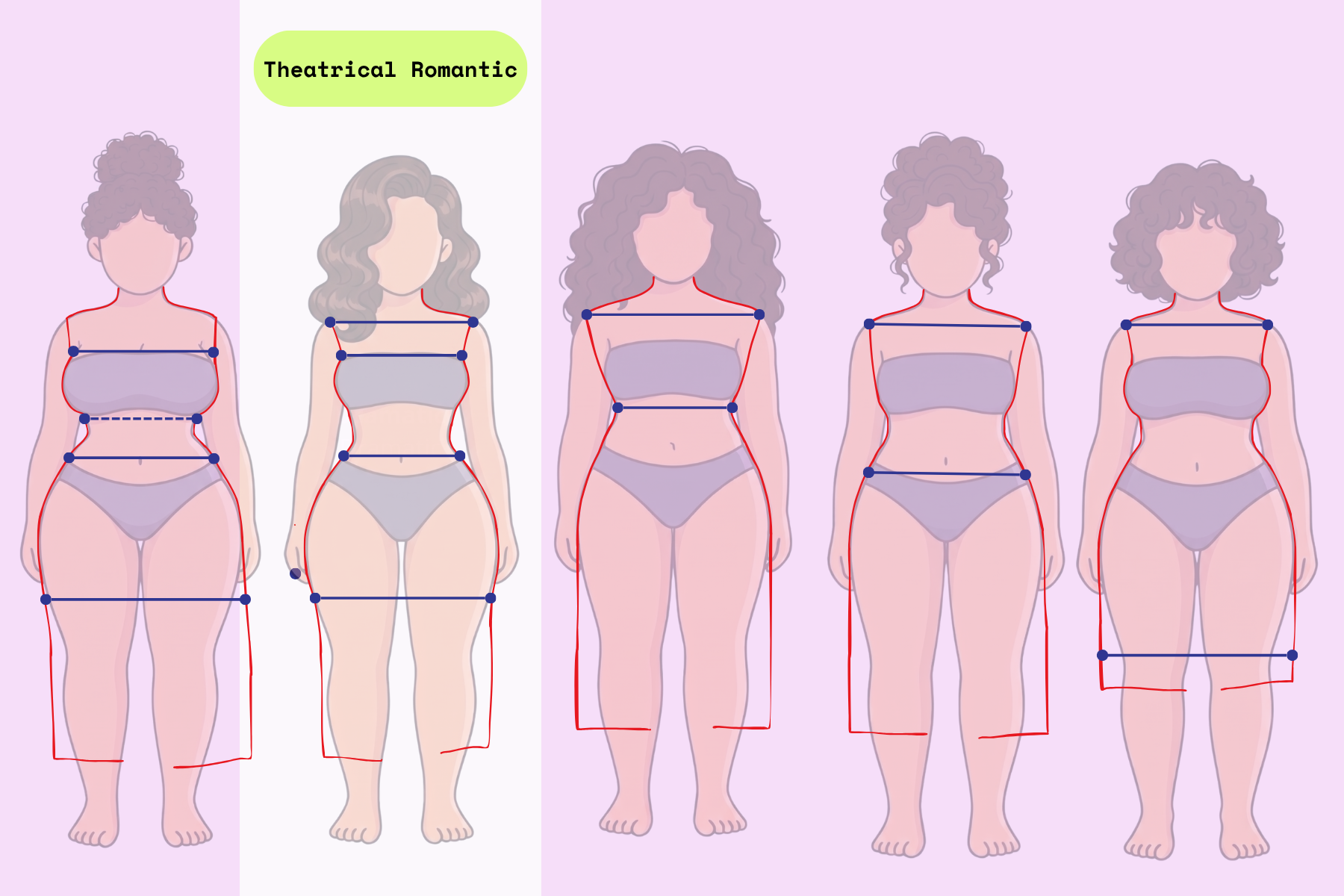
Theatrical Romantic (Curve + Narrow)
For Theatrical Romantics, the blue dots sit at the shoulders, upper waist, and lower waist, both pulling narrow.

What would the seamstress do?
She pinches the fabric at the shoulder, grabs those two dots and brings them together, shortening the line
At the waist she pulls tight and her hands move upward
She finds the two lines of dots at the hips and gently pinches them outwards.
Then pulls the fabric up slightly. A little tuck, or a little lift.
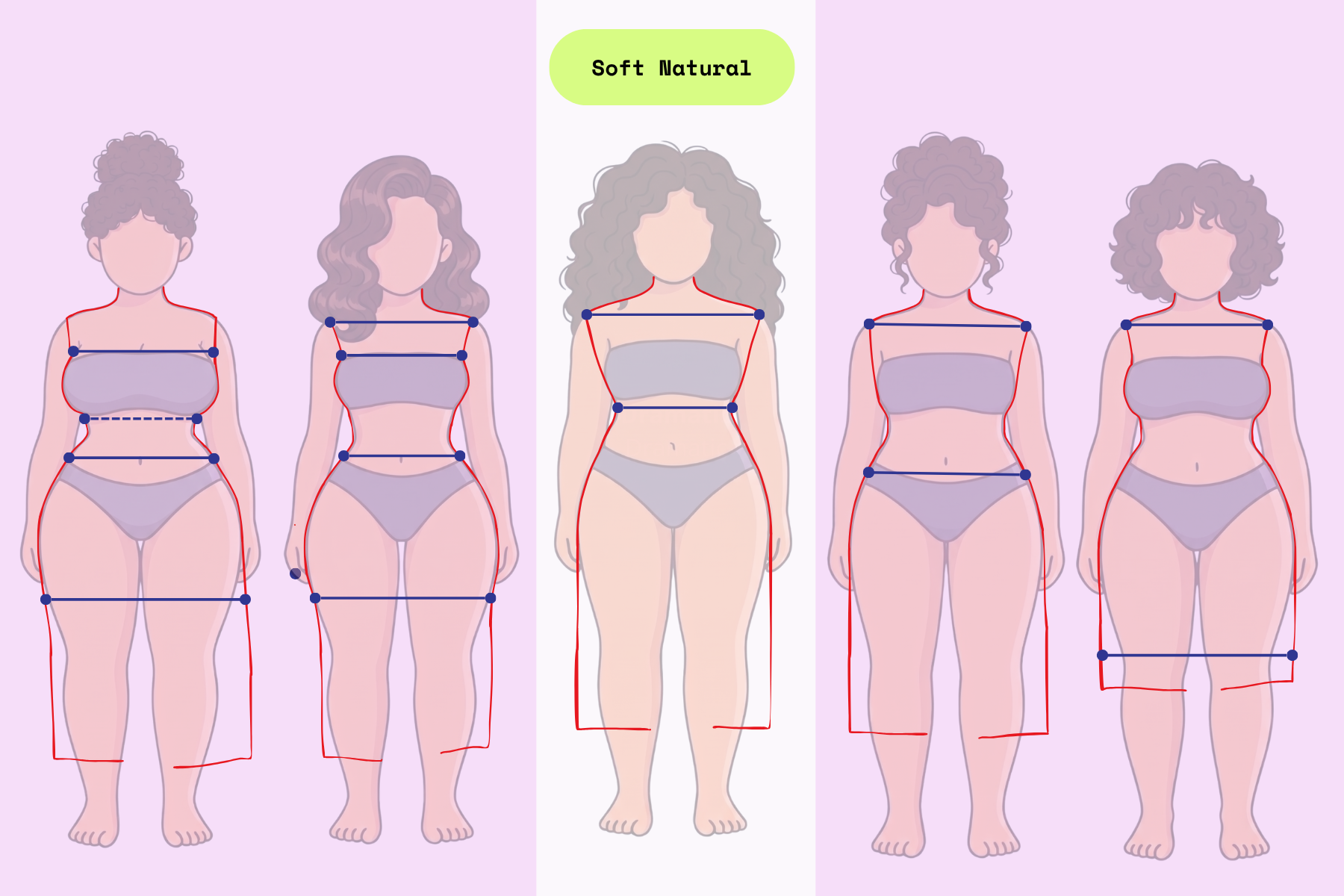
Soft Natural (Curve + Width)
For Soft Naturals, the blue dots mark the shoulders and outer hips, both pushing wide.

What would the seamstress do?
Both shoulder dots get pulled outward, then again at the upper torso
At the waist she doesn't pull tight. She shifts the fabric inward, a relaxed stretch, hoping to enhance any waist, relaxed, just suggesting there is a shape underneath
Soft Classic (Curve + Balance)
For Soft Classics, the blue dots sit at the shoulders and hips at the same horizontal level.

What would the seamstress do?
She checks the shoulder dots and the hip dots. Even. She nods.
An ever so slight tuck by the waist with the lightest inward smoothing
She steps back. Confirms the parity. Done.
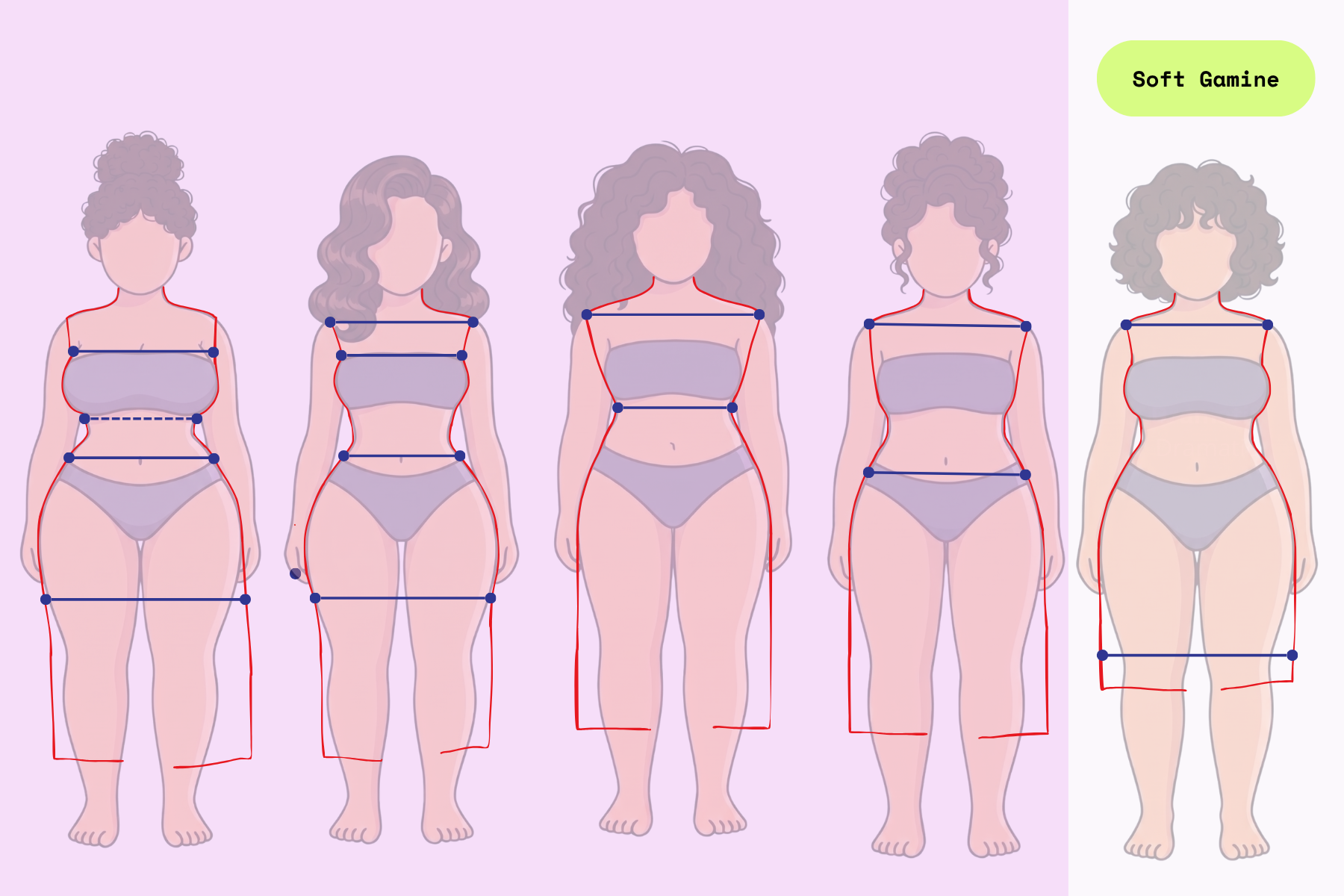
Soft Gamine (Curve + Petite)
For Soft Gamines, the blue dots mark the shoulders, waist pulling inward, and mid-leg.

What would the seamstress do?
She pulls the shoulder upward so everything sits correctly on a petite frame
Then she starts adding, a feather trim near a blue dot, a shaped hem, a detail at the collar. She's creating staccato but around curves, using yin elements, rather than straight lines
She hems the bottom. And appreciates the interruptions.
She sets down her pins.
My point is simply this: there are many ways into Kibbe, many ways to interpret Kibbe, and sometimes an unexpected lens is the one that finally makes it land. As always, this is just theory.
Related Articles
How to Do the Kibbe Personal Line Sketch for Theatrical Romantics
Information for this guide comes from David Kibbe's book The Power of Style. The book introduces the updated process for finding your Image Identity, which now includes the Personal Line.The Image...
How to Do the Kibbe Personal Line Sketch for Soft Naturals
This guide is based on David Kibbe's book The Power of Style, which covers the updated technique for finding your Image Identity with the Personal Line as its practical foundation.The Image Identity...
How to Do the Kibbe Personal Line Sketch for Soft Gamines
This guide is built on David Kibbe's book The Power of Style, which walks through the updated approach for finding your Image Identity using the Personal Line.The Image Identity FormulaImage Identity...